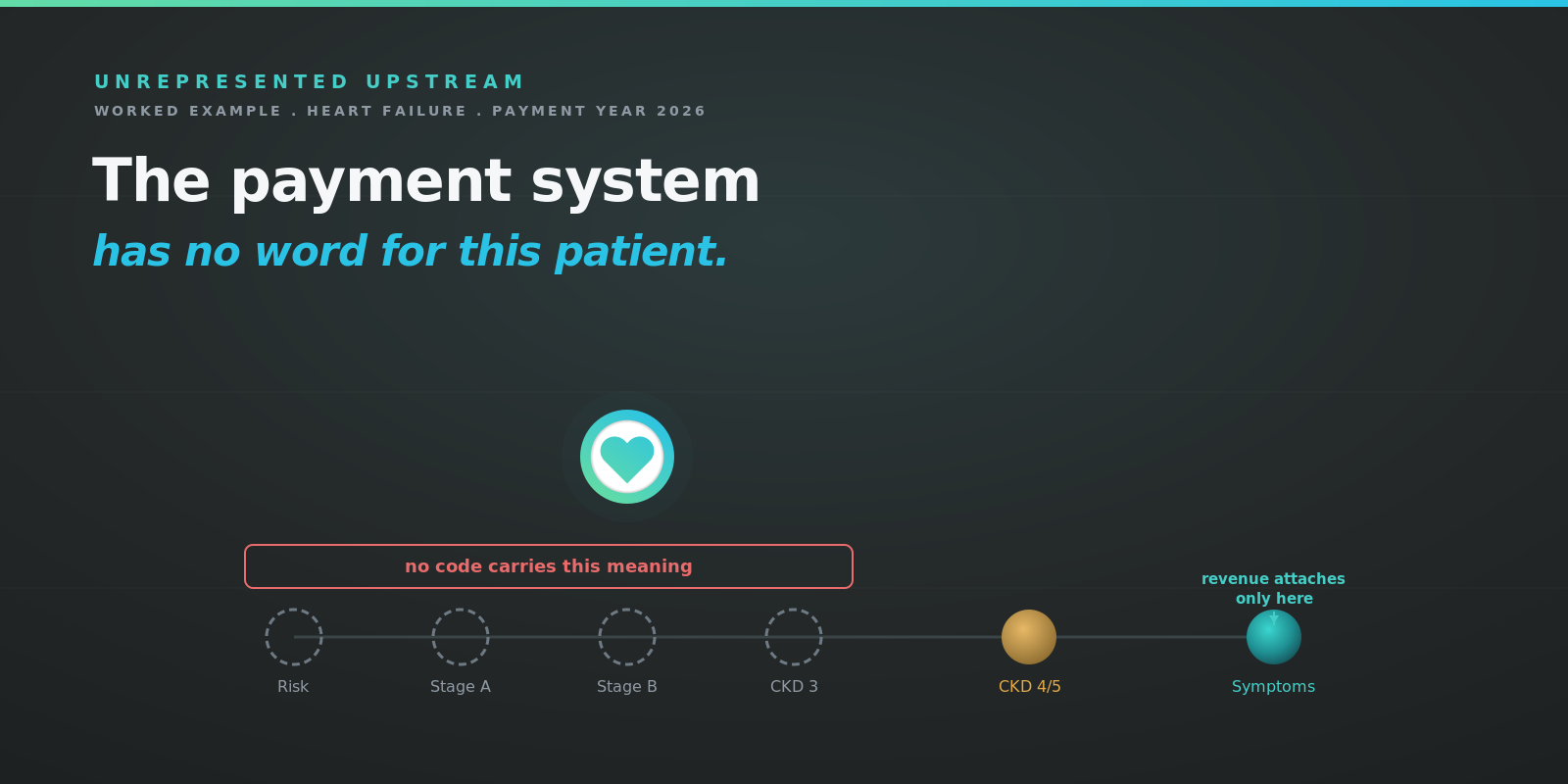
Stage B, only by calling it something it is not. No code carries that meaning, so the condition is captured through I50.9, unspecified heart failure, which does risk adjust on the medical side. CKM syndrome has no diagnosis code at all, so no. The drug model has nothing below symptomatic disease either way.
Key Takeaways
- No diagnosis code means Stage B heart failure. The condition is captured variably through I50.9, unspecified heart failure, which maps to HCC 226 and carries the full medical-side weight of symptomatic disease.
- That creates an uncomfortable choice. To make asymptomatic structural disease visible to risk adjustment, the record has to assert heart failure, which is clinically imprecise and carries documentation risk.
- The drug model offers no equivalent route. RxHCC has no cardiomyopathy category and no category below symptomatic heart failure, so the same coding workaround produces nothing on the pharmacy side.
- Chronic kidney disease shows the asymmetry inside one organ system. Stage 3 earns 0.127 on the medical side and has no RxHCC category at all, because the drug model begins at stage 4.
- RxHCC new-enrollee segments carry no disease coefficients of any kind. A member turning 65 with established heart failure, chronic kidney disease and diabetes contributes exactly zero drug-side risk until a full data collection year passes.
- CKM syndrome has no diagnosis code that captures either the condition or the stage. Academic work mapping stages to existing codes stops before payment.
- The upstream patient is not free, only unrepresented. Finding them costs Part B money, treating them costs Part D money, and neither expenditure earns a risk weight until the patient becomes symptomatic.
- Screening economics improve with time horizon. One Medicare-priced model crosses the high value threshold only after seven annual cycles, the range where a one-year contract cannot act alone.
- Right idea, possibly wrong biomarker. Excluding everyone with a natriuretic peptide at or above the screening threshold roughly doubles the association between fatigue and incident heart failure.
- This is a representation problem rather than a measurement problem, and the two require different repairs.
Where the question comes from
Companion pieces established that Medicare risk adjustment is built for reactive care across disjointed medical and pharmacy benefits, paying roughly 17 times more for a heart failure diagnosis on the medical side than the drug side, and that the drug-side weight fell 26 percent in 2026 as negotiated prices took effect.
This piece follows the reactive-care point to its furthest edge, where the patient has structural disease and the payment system has no way to say so. Both companion pieces assume a coded diagnosis of heart failure. Move upstream and the problem changes character, because the two models stop being misaligned with each other and start being absent together.
What Stage B actually codes to
The 2026 Second Universal Definition of Heart Failure reaffirms the staging system rather than revising it, and its Table 1 lists what qualifies a patient for Stage B. Structural abnormalities including left ventricular hypertrophy, chamber enlargement, wall motion abnormality, myocardial scar or fibrosis, and valvular heart disease. Abnormal cardiac function including reduced systolic function, increased filling pressures, or abnormal diastolic function. Elevated natriuretic peptide or troponin levels.
No ICD-10-CM code carries the meaning of Stage B. Searching the FY2026 Tabular List returns nothing for Stage B, pre-heart failure, asymptomatic left ventricular dysfunction, or diastolic dysfunction outside symptomatic heart failure.
What happens instead is that the finding gets forced into the heart failure family. Asymptomatic elevated filling pressures default to I50.1, left ventricular failure unspecified, the only code in the category naming a chamber without a phenotype or acuity. Elsewhere the record carries I50.9, heart failure unspecified. Both map to HCC 226 at a coefficient of 0.360, the same weight as fully specified chronic symptomatic heart failure, because V28 constrains the acuity splits to a single value.
The consequence deserves stating plainly. A plan can be paid for Stage B, at the full rate, provided the record asserts heart failure without qualification. Use of these codes is variable for exactly that reason, and they are doing work the clinical vocabulary never asked of them. Documenting an unqualified diagnosis to capture a specific pre-symptomatic state creates audit exposure and muddies every downstream analysis that depends on knowing who actually has symptomatic disease. The drug model offers no equivalent route. RxHCC has no cardiomyopathy category and nothing below symptomatic heart failure, so the same workaround yields nothing on the pharmacy side.
The instruction that does not exist
Of the qualifying findings above, valvular heart disease is the only one with specific, established ICD-10-CM codes. Rheumatic lesions sit at I05 through I08 and nonrheumatic lesions at I34 through I37, coded by valve and by lesion direction. The others have no code that records the finding. Ventricular wall motion abnormality, elevated natriuretic peptide as a finding, and diastolic dysfunction without heart failure have no code at all. Hypertrophy and chamber enlargement collapse into I51.7, cardiomegaly, which conflates two findings the staging criteria treat as distinct.
So valvular disease is the one Stage B criterion the classification can actually record. What it cannot do is connect that record to heart failure. Across all ten valve categories, the FY2026 Tabular List carries no instruction referencing I50. No code also, no code first, no use additional code. The Alphabetic Index provides no path from any valve term to heart failure. The word valve does not appear anywhere in the 121-page FY2026 Official Guidelines for Coding and Reporting.
Set that against hypertension, the other major pathway into heart failure. I11.0, I13.0 and I13.2 each instruct the coder to "use additional code to identify type of heart failure (I50.-)." Guideline I.C.9.a goes further, presuming a causal relationship between hypertension and heart involvement, to be coded as related even without provider documentation linking them. One pathway to heart failure is assumed by the classification. Another is not acknowledged at all.
| Qualifying finding | ICD-10-CM | V28 payment HCC |
|---|---|---|
| Valvular heart disease | I05 to I08, I34 to I37 | None |
| Ventricular hypertrophy | I51.7, conflated with enlargement | None |
| Chamber enlargement | I51.7, conflated with hypertrophy | None |
| Myocardial scar | I25.2, old myocardial infarction | None |
| Myocardial fibrosis | I51.4, titled myocarditis unspecified | HCC 227 at 0.189 |
| Abnormal echocardiogram | R93.1 | None |
| Wall motion abnormality | No code | None |
| Elevated natriuretic peptide | No code | None |
| Diastolic dysfunction without heart failure | No code | None |
| Rheumatic heart failure | I09.81 | HCC 226 at 0.360 |
Exhibit 2. Source. FY2026 ICD-10-CM Tabular List and Alphabetic Index, and the CMS 2026 ICD-10-CM to HCC mappings for the V28 model, verified against both the published mapping file and the model software crosswalk. The I09.81 row requires heart failure to be clinically present and is included as the one place the classification does link valve pathology to heart failure. Myocardial fibrosis reaches a payment category only as an inclusion term under a code titled myocarditis.
Read the column on the right. My earlier framing of this problem held that the structural disease gets captured while the pre-heart-failure state it establishes does not. That is wrong in the way that matters. Neither is captured. The valve code exists, appears on the claim, and carries no risk weight whatsoever.
Two guidelines, one echocardiogram, opposite meanings
The collision runs deeper than a missing instruction. Valvular heart disease has its own staging system, and it uses the same letters as heart failure staging to mean different things.
| Valve stage | Lesion and symptoms | Heart failure stage |
|---|---|---|
| A, at risk | No lesion or very mild, asymptomatic | Stage A |
| B, progressive | Mild to moderate, asymptomatic | Stage B once moderate |
| C, asymptomatic severe | Severe, asymptomatic | Stage B |
| D, symptomatic severe | Severe, symptomatic | Stage C or D |
Valve Stage C is asymptomatic severe disease. Heart failure Stage C is where symptoms begin. Same letter, opposite symptom status, one patient, one echocardiogram. The 2025 European guideline declines to use stage letters at all, recording graded severity and symptom status separately.
A classification that cannot record severity or symptom status cannot resolve which framework a given letter belongs to, which is one reason the two systems have never been reconciled in the code set.
Is there a diagnosis code for CKM syndrome?
Not one that captures the diagnosis or the stage. The American Heart Association defined cardiovascular-kidney-metabolic syndrome across stages 0 through 4 in 2023. No ICD-10-CM code names the syndrome, and none records which stage a patient occupies.
A 2026 framework published in JMIR Diabetes does the mapping work, aligning American Heart Association stages 0 through 4 to ICD-10-CM code sets using fiscal year 2026 conventions, with a hierarchical staging algorithm, co-occurrence rules and recommended lookback thresholds. The authors state plainly that CKM lacks a single ICD-10-CM code, which hinders standardized stage identification in electronic health records and claims. That work is careful and useful, and it stops where payment begins. Assembling a code set is different from reaching a condition category, and risk adjustment in both models begins with a code that maps to a category.
Does CKD stage 3 risk adjust under Part D?
No. Chronic kidney disease is the cleanest worked example, because the asymmetry is visible inside a single organ system across four coded stages. Moving upstream through the cardiovascular-kidney-metabolic spectrum, drug-side representation degrades to zero before medical-side representation does, and before a diagnosis exists both reach zero together.
Exhibit 1. Source. CMS CY2026 Rate Announcement, Tables VIII-1 for both models and Tables VIII-2 through VIII-4 for the RxHCC new-enrollee segments, which contain only age, sex, concurrent ESRD, and originally-disabled variables. The Stage A row reflects the absence of any mapped code. The Stage B row reflects a coding convention rather than a code that carries the clinical meaning. Coefficients shown for community non-dual aged on the medical side and community non-low-income aged 65 and over on the drug side.
Two readings of that table deserve care. The near-zero drug-side coefficients for advanced kidney disease are partly correct rather than simply broken. A substantial share of the drug spending for dialysis patients sits in Part B rather than Part D, because it is administered rather than dispensed. That is the medical-pharmacy divide appearing again, this time in the definition of which benefit a drug belongs to at all, and it means the 0.009 figure describes where spending was booked rather than whether the patient takes expensive drugs.
The stage 3 row has no such defense. Stage 3 chronic kidney disease is precisely the population where SGLT2 inhibitors and finerenone are indicated for renal protection, and it is precisely the population the drug model does not represent.
How large is the population nobody can code?
Large, and at high risk. Pooled data from MESA, the Cardiovascular Health Study and Framingham, covering 11,618 participants over a median fifteen years, put Stage B prevalence at 43.2 percent under the 2022 criteria and found a hazard ratio of 10.61 for progression from Stage B to symptomatic heart failure relative to Stage A. In the ARIC cohort, 81.3 percent of 5,324 older adults without prevalent heart failure met Stage B criteria, and Stage B carried nearly double the mortality risk of Stage A.
A tenfold progression gradient sits between two states, one of which the payment system cannot see at all and the other of which it can see only by asserting a diagnosis the patient does not have. The undiagnosed share is larger still in some groups. The 2026 ACC consensus pathway on preserved ejection fraction reports that up to 40 percent of community-dwelling individuals with obesity may have unrecognized heart failure on formal testing, rising as high as 70 percent among dyspneic individuals with obesity in referral populations, most of it preserved ejection fraction.
The new-enrollee gap
The last row of Exhibit 1 is the one to sit with, and it appears nowhere in the published literature on Part D risk adjustment. The RxHCC new-enrollee segments carry no disease coefficients. The tables contain age, sex, a concurrent end-stage renal disease indicator and an originally-disabled flag, and nothing else. A member turning 65 with established heart failure, chronic kidney disease and diabetes contributes exactly zero drug-side risk until a full data collection year has passed.
That is the moment of Medicare entry, which is also the moment a plan could most usefully initiate guideline therapy on someone who has been accumulating structural disease for a decade. The medical model handles new enrollees through a demographic segment that at least varies with age and disability status. The drug model, for a new enrollee, cannot tell a healthy 65-year-old from one with three chronic conditions.
The upstream population is not free
The absence of a risk category is sometimes read as meaning the upstream patient costs nothing. The opposite is true, and this is where the two benefits turn out to be tied together rather than merely adjacent.
Finding a Stage B patient costs money, and that money is Part B money. The 2022 guideline gives natriuretic peptide screening a Class 2a recommendation at level of evidence B-R, phrased as screening "followed by team-based care, including a cardiovascular specialist optimizing GDMT." Worth noting precisely, because it is often misstated, the guideline does not recommend echocardiographic screening of asymptomatic at-risk patients. Echo is the confirmatory second step once a peptide comes back elevated. The American Heart Association's cardiovascular-kidney-metabolic advisory then layers on annual kidney function and albumin-to-creatinine testing from stage 2 upward, while declining to specify a subclinical heart failure screening strategy at all, describing it as not yet defined.
Priced at current Medicare rates, a single core workup runs roughly $258 performed in a physician office and roughly $687 when the echocardiogram is done in a hospital outpatient department, where the facility payment and the professional component are billed separately.
| Component | CPT | Medicare payment | Benefit |
|---|---|---|---|
| Natriuretic peptide, BNP or NT-proBNP | 83880 | $39.26 | Part B |
| Comprehensive metabolic panel | 80053 | $10.56 | Part B |
| Urine albumin-to-creatinine ratio | 82043 and 82570 | $10.96 | Part B |
| Transthoracic echocardiogram, complete with Doppler, office | 93306 | $196.73 | Part B |
| Same echocardiogram, hospital outpatient | 93306 | $625.72 | Part B |
| Guideline-directed therapy that follows a positive finding | n/a | varies | Part D |
Exhibit 3. Source. Clinical Laboratory Fee Schedule CY2026 and Physician Fee Schedule Relative Value File RVU26A at the CY2026 conversion factor, with the hospital outpatient figure combining APC 5524 under the outpatient prospective payment system and the professional component. Constructed totals are arithmetic on those inputs rather than a published workup cost. The Part B deductible and coinsurance do not apply to clinical diagnostic laboratory tests paid under the Clinical Laboratory Fee Schedule, so the three laboratory rows fall entirely on the plan. Cost sharing can apply to associated office visits and to the echocardiogram.
Read the last two rows together. Every step required to identify the patient is paid under the medical benefit. Every step required to do something about the patient is paid under the drug benefit. A plan that wants to keep progression costs out of Parts A and B has to spend in Part D, and it has to spend in Part B first to know whom to spend on. That is the connection the series has been circling. The two benefits are not parallel tracks that happen to diverge. Upstream they are sequential, and the sequence runs from the medical benefit through the pharmacy benefit and back to the medical benefit again.
Why the sequence pays backwards
Follow one patient through the stages and watch when revenue arrives. At CKM stage 2 or heart failure Stage A, the plan spends on screening and earns no risk weight on either model. At Stage B, with structural disease or an elevated peptide confirmed, the plan spends on monitoring and on therapy, and earns nothing on the drug side. The medical side pays only if the record asserts unqualified heart failure through I50.9, which is the coding compromise described above. Both models pay cleanly only once the patient becomes symptomatic, at 0.360 and 0.135, by which point the hospitalization risk the earlier spending was meant to prevent has arrived with them.
Prospective revenue attaches to progression. The investment that would prevent progression is unfunded on both sides of the divide. The economics are not hopeless, which makes the payment gap more frustrating rather than less. The cost-effectiveness analysis from the STOP-HF trial put biomarker screening with collaborative care at roughly 1,104 euros per quality-adjusted life year and about 9,683 euros per case of ventricular dysfunction or heart failure prevented, and found the screening arm raised total direct cost of care by only 3.1 percent.
A 2024 research letter from Horton and colleagues modeled the American Diabetes Association screening strategy directly, using Medicare pricing and a Markov model of every adult with type 2 diabetes in the United States, with SGLT2 inhibitor initiation at Stage B as the intervention. The result depends entirely on how long you run it.
Exhibit 4. Source. Horton WB, Dart ME, Kavuru VS, Girton MR, Jin R, Diabetes, Obesity and Metabolism, 2024, Table 1. Markov state-transition model, Monte Carlo simulation with 10,000 trials, Medicare fee schedules, June 2022 US dollars, healthcare sector perspective, costs and quality-adjusted life years discounted at 3.5 percent. The authors describe their model as naive, note it draws probabilities from several different studies, and observe that Medicare pricing represents a likely best-case scenario. Finerenone was not modeled.
Note what the model buys and what it does not. Quality-adjusted life years are the currency of cost-effectiveness, not of a plan's income statement. A strategy can clear the high value threshold for the health system while doing nothing for the entity that has to fund it inside a contract year. The intervention modeled here is an SGLT2 inhibitor started at Stage B, which is precisely the drug the RxHCC model does not represent until the patient becomes symptomatic.
The duration finding therefore poses a question rather than settling one, and it is the right question. A seven-year horizon is precisely the range over which an entity with a one-year contract and a member who may leave cannot act on its own, which is what policy levers exist to correct. The United States Preventive Services Task Force and risk adjustment are the two instruments capable of moving a plan toward the socially optimal decision here, and neither currently does.
Right idea, wrong biomarker
Before anyone builds that lever, there is a problem with the instrument the models assume. Every screening pathway described above enters through a natriuretic peptide. The Horton model does, the 2022 guideline recommendation does, and the cardiovascular-kidney-metabolic guidance does. Recent evidence suggests the peptide is missing a large part of the population it is meant to find.
Pavlovic and colleagues followed 2,972 ARIC participants with Stage B heart failure, mean age 76, for a median of 8.4 years, through 338 incident heart failure events. Rather than a biomarker, the exposure was fatigue, measured with two validated scales covering general fatigue and exertional fatigue.
Exhibit 5. Source. Pavlovic et al., Journal of the American Heart Association, 2026, volume 15, article e046789, with the sensitivity analysis from Table S11 of the supplement. Hazard ratios for incident heart failure versus low or no fatigue, adjusted for age, race, education, sex, smoking, alcohol, body mass index, antihypertensive use, systolic blood pressure, diabetes, coronary heart disease, atrial fibrillation, depressive symptoms, estimated glomerular filtration rate, triglycerides and total cholesterol.
Look at what happens across the two rows in each pair. Removing everyone with a natriuretic peptide at or above 125 picograms per milliliter, the conventional screening threshold, does not weaken the association. It roughly doubles it. Exertional fatigue moves from a hazard ratio of 1.86 to 3.95. The reading is uncomfortable for the screening strategy. Fatigue is identifying elevated risk concentrated in exactly the people a peptide-gated pathway would send home. A screening program entered through NT-proBNP does not merely miss this group, it selects against them.
Two further findings sharpen it. All three fatigue categories predicted incident heart failure with preserved ejection fraction, and none predicted reduced ejection fraction, which puts the signal in the half of heart failure the economic literature has modeled least. The fatigue groups also reported markedly worse quality of life before any clinical diagnosis, at 11.48 points lower on the physical score for the group reporting both types. So the horizon argument and the instrument argument point in different directions. Screening upstream is probably the right idea, and the biomarker the models are built around may be the wrong entry point. A two-question symptom instrument costs nothing, has no fee schedule line, and appears in no risk model at all.
What Medicare does pay for upstream
The guidelines have moved faster than the classification. The 2026 cardiovascular-kidney-metabolic guideline carries a Class 2a recommendation that among adults with predicted ten-year heart failure risk at or above 5 percent on the PREVENT equations, evaluation for pre-heart failure using natriuretic peptides and high-sensitivity troponin "can be beneficial to guide additional diagnostic testing and coordinated care for optimal HF prevention." That is a recommendation to detect a state with no code and no risk weight.
Fee-for-service billing has moved faster too. The 2025 Physician Fee Schedule created two codes for exactly this population. G0537 pays for administering a standardized cardiovascular risk assessment to a patient who has risk factors but no cardiovascular diagnosis, once every twelve months, at a work relative value unit of 0.18. G0538 pays monthly for risk management services once that assessment returns intermediate or higher risk.
Read what those codes do and do not do. They pay a fee for an encounter. They create no condition category, they enter neither risk model, and they generate no prospective revenue attached to the patient. A plan can be paid for assessing cardiovascular risk and earn nothing for carrying it. The codes are also ASCVD-specific rather than heart failure codes, so the population this piece describes is served only where the two overlap. Worth noting as well that risk management is not classified as a preventive service, so patient cost sharing applies to G0538. An earlier piece examined the gap between what clinicians can now compute and what the adjudicating payer can see in what PREVENT prevents.
The structural claim
Moving upstream through the cardiovascular-kidney-metabolic spectrum, drug-side representation degrades to zero before medical-side representation does, and before a diagnosis exists both reach zero together. The population where pharmacologic prevention carries the highest expected value is the population neither model can describe.
Upstream of Stage B a mapping between the CMS-HCC and RxHCC models cannot be built at all, because neither side has anything to map. At Stage B itself the medical model can be reached, though only by asserting a diagnosis the patient does not yet have. Both are different failures from the one the companion pieces describe.
A calibration moat exists wherever two payment models are fitted against disjoint cost pools for the same population. Both models can be individually well specified and accurate within their own pool. The limitation appears only in the space between them, where a substitution from one pool to the other remains invisible in both dependent variables.
The moat has a floor as well as two banks. Where a clinical state carries no mapped code, the models produce no signal to reconcile, and the gap stops being a measurement problem and becomes a representation problem. Those are different repairs. Pricing a substitution between benefits requires a model that spans both pools. Representing a patient upstream of diagnosis requires vocabulary that does not yet exist. An earlier piece examined that vocabulary gap on its own terms in heart failure's Stage A and B blind spot. What the risk models add is that the gap is doubled. The code does not exist, and neither of the two payment consequences that would follow from it exists either.
The same problem, by seat
| Role | The question worth answering now |
|---|---|
| Medicare Advantage plan | Your care management program for rising-risk members generates no prospective revenue on either model. How is that program funded, and what happens to it in a tight bid year? |
| Health system in risk | Your risk adjustment capture strategy stops at diagnosed disease, because that is where the categories start. What is the size of your attributed population in CKM stages 1 through 3? |
| Quality and measure developers | A staged CKM concept with no coded representation cannot be measured, risk adjusted, or paid for. Which comes first in your roadmap, the measure or the vocabulary? |
| Manufacturer, cardiorenal | Your indication is expanding upstream. The upstream population carries no risk weight on the benefit that pays for your product. How does that change the access case? |
| Analytics and risk vendors | Every published risk adjustment product targets diagnosed disease. What would a stage-aware upstream model be worth to a plan that cannot currently see the population at all? |
| CMS and policymakers | Prevention is the stated goal across several programs, and neither risk model can represent a patient before diagnosis. Is a staged condition category the missing instrument? |
Erik's Hot Take
The gray space is that a clinically coherent and increasingly well-evidenced concept, the staged progression from risk to structural disease to symptoms, has no representation in the payment system that decides what gets funded. The guideline moved. The vocabulary did not.
The white space is a definitional one, and definitional white space is rare. Whoever builds a defensible claims-based representation of the upstream population, validates it against outcomes, and demonstrates its predictive value on both expenditure pools will be holding the input that both risk models currently lack. That is a longer play than a coefficient argument, and a more durable one.
It is also a live one. The ICD-10-CM Coordination and Maintenance Committee heard proposals in September 2026 covering heart failure Stage A and Stage B, heart failure with improved ejection fraction, and cardiogenic shock staging. A code titled pre-heart failure, Stage B was among them, carrying an exclusion from the heart failure category and an instruction to code also the qualifying finding. Nothing has been adopted, and the Committee is explicitly barred from weighing reimbursement in these decisions.
That last constraint is worth sitting with. The vocabulary gap and the payment gap are the same gap viewed from two sides, and the body that could close the first is required to ignore the second. Anyone arguing this case has to make it twice, in two rooms, in two languages.
Frequently asked questions
Does CKD stage 3 risk adjust under Part D?
No. The RxHCC model has no chronic kidney disease category below stage 4. Stage 3 and stage 3B map to HCC 328 and HCC 329 at 0.127 on the medical side and to nothing on the drug side, despite being the population where SGLT2 inhibitors and finerenone are indicated for renal protection.
Is there a diagnosis code for CKM syndrome?
No code names cardiovascular-kidney-metabolic syndrome, and none records which stage a patient occupies. Academic work has assembled sets of existing ICD-10-CM codes that approximate each stage, which is useful for research and phenotyping. Assembling a code set is different from reaching a condition category in the CMS-HCC or RxHCC models.
What risk score does a new Medicare enrollee with heart failure carry in Part D?
None attributable to heart failure. The RxHCC new-enrollee segments contain only age, sex, a concurrent end-stage renal disease indicator and an originally-disabled flag. No disease coefficients exist in any new-enrollee segment, so chronic conditions contribute zero drug-side risk until a full data collection year has passed.
If there is no risk weight upstream, does the upstream patient cost the plan anything?
Yes. Identifying the patient requires natriuretic peptide testing and, where that is elevated, echocardiography, all paid under Part B. Guideline-directed therapy that follows is paid under Part D. A plan that wants to keep progression costs out of Parts A and B has to spend in Part D, and has to spend in Part B first to know whom to treat. Neither expenditure earns a risk weight until the patient becomes symptomatic.
How do you code Stage B heart failure?
No code carries the guideline meaning. In practice the condition is captured through I50.9, heart failure unspecified, which does risk adjust to HCC 226. Some coders instead document the underlying structural abnormality where one is established, such as a cardiomyopathy or a valvular condition, which may or may not reach a payment category. Use of I50.9 for an asymptomatic patient asserts heart failure without qualification, which carries documentation risk.
What is a calibration moat?
A calibration moat exists wherever two payment models are fitted against disjoint cost pools for the same population. Each model predicts its own pool well. Neither can price a substitution between them, because the substitution does not appear in either dependent variable. Better data integration does not resolve it, because the constraint is the model specification.
Method and sources
Coefficients and model structure come from the CMS CY2026 Rate Announcement, Tables VIII-1 for both models and Tables VIII-2 through VIII-4 for the RxHCC new-enrollee segments. Statements about the absence of coded representation reflect the ICD-10-CM to condition category mappings CMS publishes for payment year 2026. The absence of an RxHCC category below chronic kidney disease stage 4, and the absence of disease coefficients in every RxHCC new-enrollee segment, are properties of the published model rather than inferences.
Fatigue and incident heart failure figures come from Pavlovic et al. in the Journal of the American Heart Association, 2026, with the natriuretic peptide sensitivity analysis from Table S11 of the supplementary material. The cardiovascular-kidney-metabolic coding framework is Ndumele and colleagues in JMIR Diabetes, 2026, article e91827. Cost-effectiveness figures come from Horton et al. in Diabetes, Obesity and Metabolism, 2024, a research letter the authors describe as using a naive model, and from the STOP-HF cost-effectiveness analysis. Cardiovascular risk assessment code descriptions come from the 2025 Medicare Physician Fee Schedule final rule, with G0537 at a work relative value unit of 0.18 billable once every twelve months and G0538 billable monthly for patients at intermediate or higher risk without an ASCVD diagnosis.
Clinical staging reflects the 2022 AHA, ACC and HFSA heart failure guideline, the 2026 Second Universal Definition of Heart Failure, and the American Heart Association's 2023 presidential advisory defining cardiovascular-kidney-metabolic syndrome. Rows describing Stage A and Stage B reflect the absence of a mapped category rather than a published coefficient of zero, and that distinction matters for anyone reproducing the analysis.
This piece is analysis and commentary based on public sources and professional experience as of the date noted, and nothing in it constitutes legal, clinical, or financial advice. Descriptions of risk adjustment and coding practices are general characterizations of common industry structures and are not directed at any specific company or plan. Interpretive conclusions are the author's opinion, offered for analytical discussion. All views reflect independent professional judgment and do not represent the views or positions of any current or former employer or affiliated organization.